Site items in: Perth 2025

Article

Despite the successes and progress made in 2025, the year remains a missed opportunity for ammonia energy. The first complete supply chains for renewable ammonia are emerging, and some 600,000 tons of annual production capacity is set to be online in northeast China early next year. Maritime engines, cracking, and power & heat technology solutions also made their mark, moving from feasibility into deployment. But disappointing outcomes at the IMO and government support that failed to spark market development remains an issue, with plenty of critical, detail-heavy work ahead of us in 2026.

Article

A new strategy roadmap launched alongside the recent AEA APAC conference envisions Port Hedland in the Pilbara region as a major clean fuel bunkering hub. In news from roadmap partners, Oceania Maritime Energy and SeaTech Solutions have received approval in principle for their ammonia bunkering vessel design (also at the APAC conference), and BHP has signed time charter contracts for two ammonia dual fuel Newcastlemax bulk carriers to carry iron ore to northeast Asia.

Presentation

The Dampier STS ammonia transfer trial yielded a number of important learnings and findings. This presentation also looks at the location of the ammonia transfer within the Port of Dampier, and how the current outer anchorage layout is well-suited for ammonia fuel bunkering.

Presentation

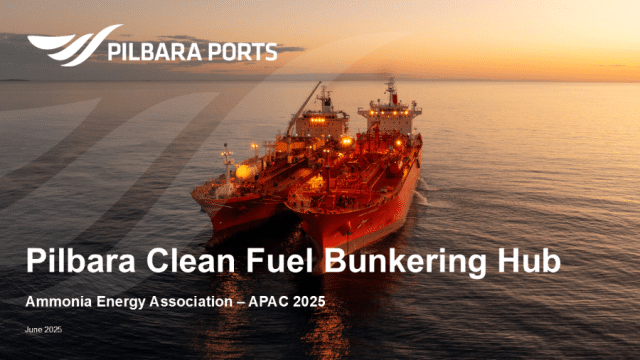
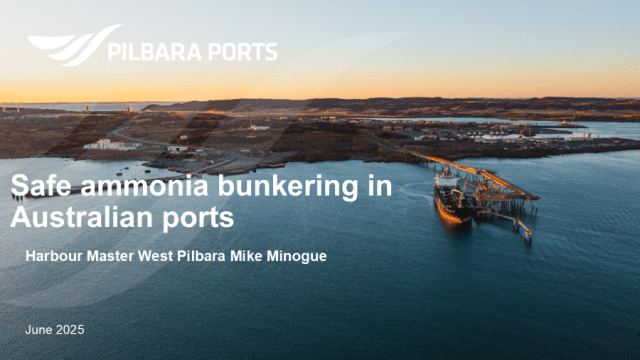
Pilbara Ports is working to establish the Pilbara Clean Fuel Bunkering Hub, enabling port users to bunker locally-produced low carbon ammonia as a marine fuel. Our goal is for 100 per cent of bulk export vessels departing the Pilbara to be powered by clean fuels. This presentation analyses some of the findings from our initial workstreams, including the penalty costs for the Pilabar export fleet under the new IMO emission pricing framework, fuel demand forecasts, and anchorage options. The presentation coincides with the release of Pilbara Ports Authority’s new Clean Fuel Bunkering Hub Strategy.

Presentation

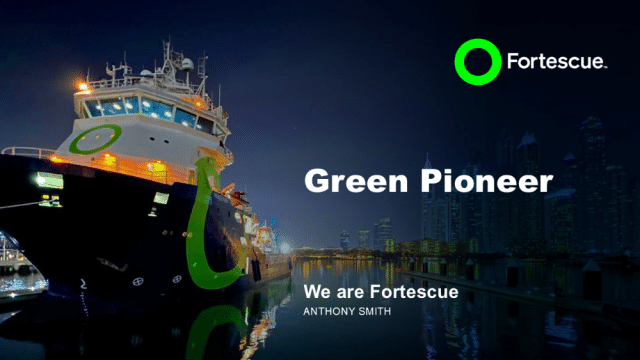
The Green Pioneer project has seen huge success in just a few short years, and included many important steps. From design, HAZID/HAZOP, AiP, certification and extensive testing, multiple sea trials have taken place in several global locations. Safety underpins both design and operational decisions made during the project, and emergency response and intervention capabilities are both well-established. *this presentation is not publicly available