Site items in: Distributed ammonia synthesis

Comparative Technoeconomic Analysis of Conventional and Absorbent-Enhanced Ammonia Synthesis
Presentation

Ammonia is the second-most produced synthetic chemical and the main precursor for nitrogen-based fertilizer. In 2015, 160 million tons were produced globally, and global demand is expected to grow 1.5% annually until 2050 [1]. However, traditional ammonia production uses natural gas or coal as its hydrogen source, and as a result, is also responsible for more than 1% of global GHG emissions and 5% of global natural gas consumption [2]. Clearly, a more sustainable ammonia production scheme is needed. One such alternative is obtain hydrogen from electrolysis powered by wind- or solar-derived electricity. It has been proposed to perform this…
Ammonia as an Energy Carrier – Update from the Netherlands
Presentation

Proton Ventures specializes in ammonia and energy related matters in four ways: Terminal storage and handling (bulk) NFUEL Small scale ammonia production DeNOx and N2O removal systems Battolyser Technology (electrolysis and battery storage in a single appliance) Recently, Proton Ventures welcomed new venture capital from Koolen Industries allowing further growth, development and market penetration of the new small scale ammonia production technology. Momentum is increasing: across the globe, we have some great leads in various stages of development. Can multiple small scale production trains actually be a smart solution for the larger production capacity requirements when fluctuation of either the…

Arpa-E Refuel Program: Distributed Production of Ammonia and Its Conversion to Energy
Presentation

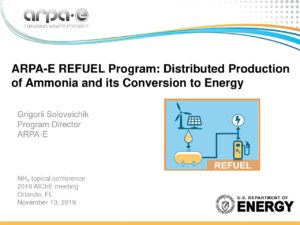
Ammonia, which has high energy density in easily produced liquid form and can be converted to electric or motive power, is considered to be an almost ideal non-carbon energy vector in addition to its common use as a fertilizer. It can be manufactured anywhere using the Haber-Bosch process, effectively stored, transported and used in combustion engines and fuel cells as well as a hydrogen carrier. Transition from fossil fuels as the energy source and feedstock to intermittent renewable energy sources will require a shift from large scale Haber-Bosch plants (1,000 – 1,500 t/day) to distributed ammonia production matching electrical power…

Optimizing Absorptive Separation for Intensification of Ammonia Production
Presentation

High pressure requirements of Haber-Bosch process imposes substantial operating (e.g., compression) and capital (compressor cost, advanced costly alloys, thick reactor casing, etc.) expenses in the ammonia production. Cost considerations force ammonia producers to take advantage of the economy of scale to drive down the manufacture cost, while small and energy-efficient processes that can be powered with off-grid renewable energy are required for ammonia-mediated hydrogen economy. Small-scale reaction-absorption process is proposed to be a viable technology to reduce the operating pressure requirements of Haber-Bosch process.1–4 Here, we present an overview of our efforts to further intensify ammonia production via reaction-absorption process.…

Technoeconomic Requirements for Sustainable Ammonia Production
Presentation

Ammonia, the feedstock for all nitrogen fertilizers, is produced via the Haber-Bosch process, which is responsible for 1-2% of global carbon dioxide emissions each year. An attractive solution to this problem is to create an electrochemical ammonia synthesis process that can produce ammonia using only air, water, and renewable electricity. Researchers across the world have been working toward such a solution for the last several decades, but so far, no economically viable alternative has been created. The Haber-Bosch process is one of the largest-scale, most highly optimized chemical processes in the world; it is very difficult to find a cheaper…

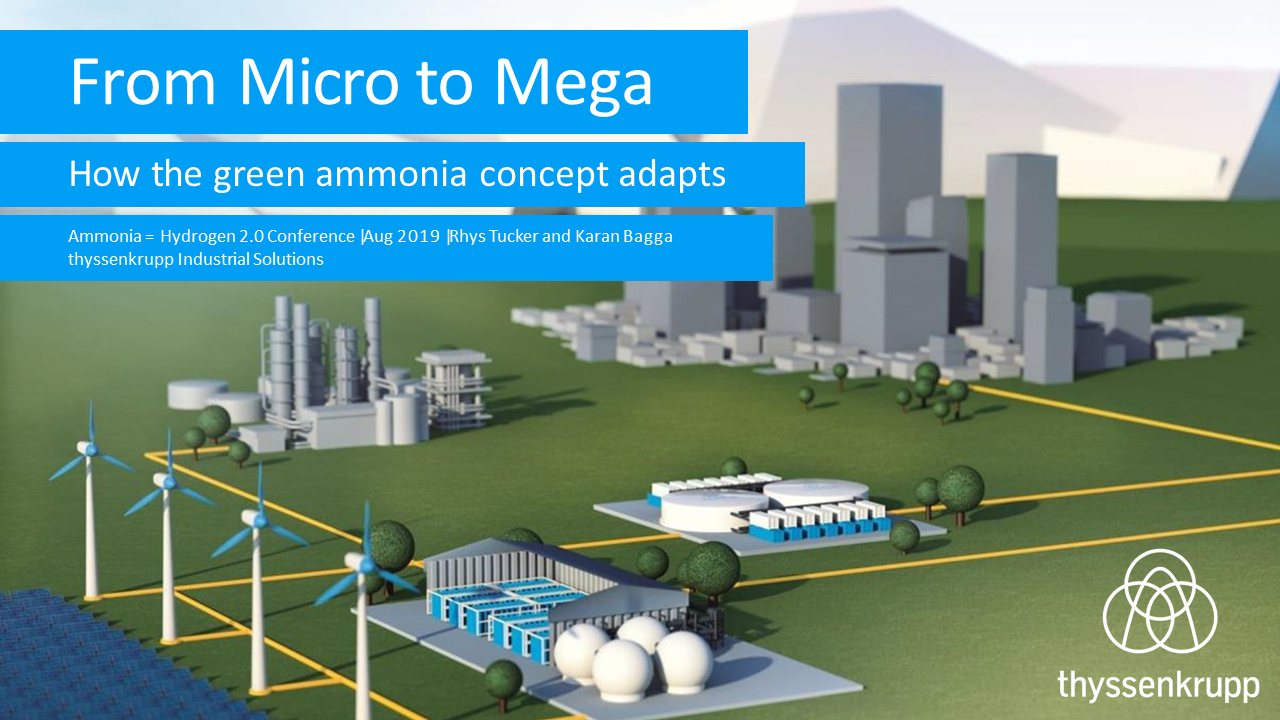
From Micro to Mega, how the green ammonia concept adapts
Presentation

Green ammonia concepts from thyssenkrupp are available from 50 to over 5000 tonnes per day. Variability of electrolytic hydrogen feed presents one of the biggest and unique challenge in achieving an optimal and stable functioning of the Haber-Bosch synthesis loop. The solutions to these challenges require a customised approach, dependent on scale and power generation mix of the of the facility. At thyssenkrupp, Australia, we offer local expertise in optimising the concepts for your small and large scale green ammonia applications, underpinned by our know how as a world leading electrolysis and ammonia technology supplier.

RAPID: supporting modular manufacturing and process intensification for small-scale ammonia
Article

Using greener feedstocks at low pressures and temperatures, with higher conversion rates and less greenhouse gases is considered a pipe dream. The technology and equipment simply wasn’t available ... until now. The case for small-scale, energy efficient ammonia production is well documented, but access to funds may not be. Now, Manufacturing USA and the Manufacturing Extension Partnership may offer a new path to success.

Design Optimization of an Ammonia-Based Distributed Sustainable Agricultural Energy System
Presentation

Small-scale, distributed production of ammonia better enables the use of renewable energy for its synthesis than the current paradigm of large-scale, centralized production. Pursuant to this idea, a small-scale Haber-Bosch process has been installed at the West Central Research and Outreach Center (WCROC) in Morris, MN [1] and there is ongoing work on an absorbent-enhanced process at the University of Minnesota [2], [3]. Using renewables to make ammonia would greatly improve the sustainability of fertilizer production, which currently accounts for 1% of total global energy consumption [4]. The promise of renewable-powered, distributed ammonia production for sustainability is in fact not…

Advances in Making High Purity Nitrogen for Small Scale Ammonia Generation
Presentation

The presentation will address recent developments in the Solar Hydrogen Demonstration Project in which hydrogen, nitrogen and ammonia are made from solar power, water, and air; and used to fuel a modified John Deere farm tractor. In industrial applications very pure nitrogen is made by cryogenic distillation of air. Using Pressure Swing Absorption systems alone it is extremely difficult to achieve the required purity. An improved method was developed for making high purity nitrogen, for smaller systems. Will discuss how, when Oxygen contaminates the reactor catalyst, Hydrogen is used to purge the catalyst, and subsequently used as fuel.