Air Liquide: Ammonia cracking in the Port of Antwerp-Bruges
By on April 24, 2026
In our early April episode of Project Features, we explored Air Liquide’s industrial-scale ammonia cracking pilot unit at the Port of Antwerp-Bruges in Belgium, as well as the emerging standards and regulations around hydrogen and ammonia. Michael Lutz (Senior Innovation Process Engineer, Engineering & Technologies), Laurent Prost (Head of HyCO Process Solution Development, Engineering & Technologies), and Guy de Reals (Director Regulation Codes & Standards, H2 Energy) were joined in conversation by AEA Technology Manager Kevin Rouwenhorst.
The ammonia cracking landscape

Click to expand. Historical and new applications for ammonia cracking. From Kevin Rouwenhorst, April 2026 Project Features introduction.
Ammonia cracking has historical applications like metallurgy and heavy water production. New possible applications include engines, fuel cells, gas turbines, and industrial hydrogen supply at energy import hubs. These applications range in size from a few kilograms of hydrogen production per day, to hundreds of tons of hydrogen production per day. Although applications such as maritime engines and gas turbines have increasingly focused on direct ammonia fueling in recent years (sometimes in combination with a pilot fuel), ammonia cracking and purification will be required for applications such as hydrogen for fuel cells and industrial-scale hydrogen supply at energy import hubs.
The January 2026 edition of LEAD: Infrastructure tracks 31 industrial-scale ammonia cracking projects under development, for a combined capacity of 2.5 million tons of hydrogen (14.9-18.4 million tons of ammonia). Most projects are still in early stages of development, but various ammonia cracking demonstrations are ongoing in Europe:
- Air Liquide’s operational 30 tons of ammonia per day ammonia cracker in Antwerp (Belgium).
- Uniper & thyssenkrupp Uhde’s 28 tons of ammonia per day ammonia cracker in Gelsenkirchen-Scholven (Germany), currently under construction and will start operations in early 2027.
- Höegh Evi’s operational ammonia cracking pilot in Norway, with BASF ammonia cracking catalysts.
- Duiker’s AMMONEX ammonia cracking pilot in Rotterdam (the Netherlands), with operations planned for 2027.
De-risking is still required for various aspects of ammonia crackers for industrial hydrogen supply, namely for catalyst performance, material resistance to nitriding, burner configurations and fuel mixes, cracked gas purification, and especially integrated plant performance.
Air Liquide’s industrial-scale ammonia cracking pilot
Air Liquide is a world leader in gases, technologies, and services for industry and healthcare, operating in 59 countries and producing oxygen, nitrogen, hydrogen, and other essential molecules. The Group builds, owns, and operates its own assets and also provides technology solutions to its customers. Over several decades, Air Liquide has constructed approximately 145 steam methane reformers (SMRs), with more than 80 SMRs and HyCo plants currently in operation.

Click to learn more. The ARCAS ammonia cracking pilot plant at the Port of Antwerp-Bruges. Source: Air Liquide.
In 2023, Air Liquide announced its investment in the industrial-scale ammonia cracking pilot at the Port of Antwerp-Bruges (Belgium). In November 2025, Air Liquide successfully started-up its cracking pilot. The ammonia cracking pilot unit is capable of processing around 30 tons of ammonia per day.
The ammonia cracking technology is based on Air Liquide’s SMR-X™ technology (used in steam methane reforming for hydrogen production), introducing a counter-current helix-heat exchanger inside the reactor tubes, to improve the energy efficiency of the overall process.
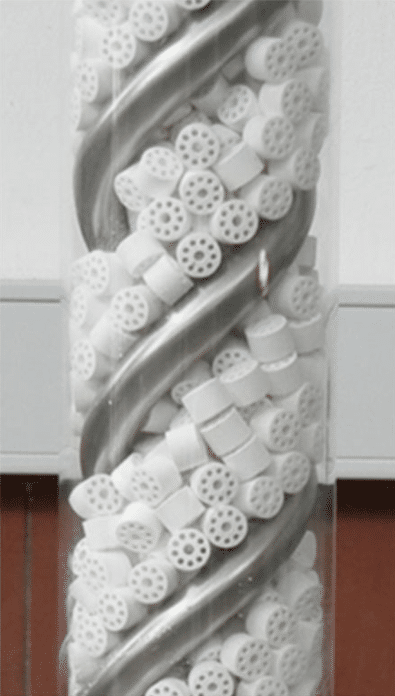
Click to expand. A model of the Air Liquide SMR-X™ tube with the internal helix-heat exchanger. Source: Air Liquide.
The experience from the industrial scale-up of the proprietary SMR-X™ technology was leveraged to reach commercial maturity. The roadmap integrated a comprehensive R&D program, encompassing lab- and technical-scale pilots, with a flagship industrial-scale pilot plant now operational at the Port of Antwerp-Bruges. Data harvested from these experimental phases served as the foundation for precision ammonia cracking simulations. By benchmarking these models against ongoing pilot campaigns, Air Liquide achieved the precise calibration and optimization required for world-scale performance.
Consequently, commercial-capacity ammonia cracking plants can now be deployed with full confidence in their scalability. The pilot validates all critical components at their final design scale, including the specialized catalysts, reformer tubes, high-efficiency burners, and the complete balance-of-plant: from the inlet-outlet manifolds and vaporizers to the ammonia pumps and integrated DeNOX abatement systems.
This development effort included the rigorous validation of specialized catalysts through over 3,000 hours of continuous operation in the industrial pilot to confirm thermomechanical resilience. Furthermore, Air Liquide addressed the critical operational challenge of nitridation, a specific form of high-temperature corrosion, through extensive studies on various alloys and coatings to ensure long-term material integrity.
This comprehensive process paves the way for the full commercialization of Air Liquide’s ammonia cracking technology, marking a key milestone toward reliable, large-scale, low-carbon hydrogen supply.
Emerging standards and regulations for hydrogen and ammonia
Various standards and regulations are emerging to determine greenhouse gas (GHG) emissions for hydrogen production and other steps in the value chain – including ammonia cracking.
There are a few key differences between standards and regulations. Standards define the generic rules to establish the carbon footprint of a product or activity, and their chain of custody. Examples of standards are those of the International Organization for Standardization (ISO) and the Greenhouse Gas Protocol. Regulations (or policy frameworks) define the criteria to access public incentives, with specific rules to define these criteria. An example is the EU ETS Monitoring Reporting and Verification Regulation, which specifies how one should account for emissions of a specific activity to comply in the EU Market. Another example is the RED III DA (Renewable Energy Directive III Delegated Act), defining how renewable fuels can qualify to count toward the European decarbonization targets.
Standards provide methodologies and may thus enable public policies, but these do not define the rules in the policy framework. Technology providers will need to adapt their technologies to comply with jurisdictions around the world. In the context of ammonia cracking, load following requirements will vary per region, as well as the carbon footprint scope and the emission threshold.

Click to expand. Examples of the hydrogen supply chain and coverage of ISO 19870 series, as set out in ISO 19870-1.
ISO is progressing with the upcoming series of ISO 19870 standards as part of the Technical Committee (TC) 197. The ISO 19870 standards will provide guidance for greenhouse gas (GHG) emission allocation for hydrogen production, and derivatives production, storage, transport, and conversion. The ISO 19870 standards are set for publication in 2026 and 2027.
ISO 19870-1 focuses on hydrogen production via various technology pathways. ISO 19870-2 focuses on hydrogen liquefaction, as well as liquid and gaseous hydrogen transport. ISO 19870-3 focuses on ammonia production, ammonia storage, ammonia transport, and ammonia cracking. The seed document for the ISO 19870-3 standard was drafted by an Ammonia Energy Association Task Force. ISO 19870-4 focuses on the LOHC (liquid organic hydrogen carrier) value chain.
The ISO 19870 standards will have both a normative attributional approach for emission allocation, and a consequential approach for broader systemic impacts (also catering to regulations). The ISO 19870 standards build upon a generic corpus of standards for lifecycle in the ISO, defined under TC207 (dedicated to environmental management), among which standards for inventories of organizations and projects (ISO 14064-1 and ISO 14064-2), and carbon footprints of any products (ISO 14067).
You can access the recording of the webinar below, and download the speaker slides here.